Cultural Excursion to Nakhon Si Thammarat


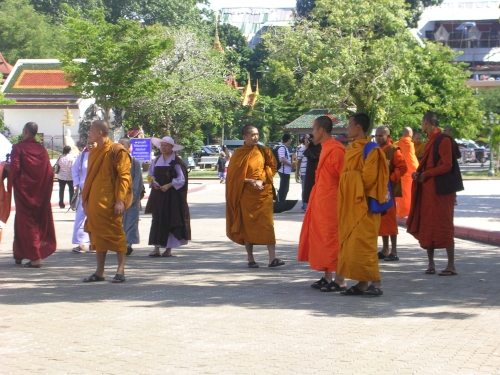
As a part of Orientation Program (1st Semester) July 2009, IBC organized a cultural excursion to Nakhon Si Thammarat, an ancient city with large community that is at least 1,500 years old. The journey started at 6 o'clock with a greeting of sunshine and ended with downpour of monsoon rain, cooling down the muggy 8 hours long tour. Participation of new as well as old students together with IBC teachers and Director of Students Affairs Ven. Zhen Chan enlivened the journey. Different students coming from different countries and cultural backgrounds brought colourful cultural exchanges during the journey.
Nakhon Si Thammarat, the coastal sand bank on the Gulf of Thailand that stretches for at least 100 kilometres was the location of the Tambralinga land. The existence of the province has appeared in various documents and dispatches since the 6th-7th Buddhist century under different names such as Tambralinga, Tan Ma Ling, Lochac, Si Thammarat, Siri Tham Nakhon, Nakhon Don Phra, and Ligor. This province was the heart of different religious and cultural exchange as well as a hub for travelers and traders in the Thai-Malaysian peninsula since 5th century AD.
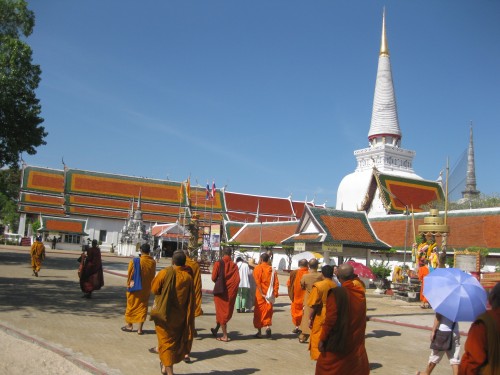
First we visited an old Buddhist temple called Wat Phramahathatworamahavihara that has been with the city since very long time. Locals call the temple by names "Wat Phra That and Wat Phra Maha That". The origin of the temple is clouded in mystery, only legends are told. The temple has several religious artifacts and historical sites, the most important being "Phra Borom That Chedi" pagoda where the holy relics of Lord Buddha are kept.
Nikhon Si Tammarat National Museum is the main Regional Museum of the southern part of the kingdom of Thailand. The fine arts department has assigned the museum to be a centre for education and for the preservation and tourism promotion of the art and the culture of Nakhon Si Thammarat and the upper southern area. Museum displays some historical artifacts of Buddhism and Hindu Bramhanism, cultural and ethnic artifacts, which makes the museum an exotic place to visit.
City Museum of Nakhon Si Thammarat was another interesting site to visit. It was fully equipped with modern technology depicting the ancient artifacts. It has four main buildings, Thirdthai Rajhini, Veerathai, Ruamjaipak and Nanak-rote. The City Museum also has a park nearby known as "Buddhabhumi" meaning the land of Buddha. It covers 25 acres of land. It displays four important places. First, Lumbini park, the birth place of the Buddha; second Buddhagaya, the place where Buddha attained full Enlightenment; third Saranath in Baranasi where the Buddha peached his first discourse (Dhammacakkapavattanasutta) to the Five Disciples; and fourth Kusinara, the place where Buddha attained final rest, Parinibbana.
This cultural excursion to Nakhon Si Thammarat was very educational and also entertaining. Students had the opportunity not only to learn about the cultures of Nakhon Si Thammarat, but also to know their peers and their cultural backgrounds. Some students felt that such tours are really important to foster fraternity among students and IBC members.
(Reported by IBC students Ven. Assaji Tanchangya, Mr. Bibek Sharma and Ven. Thammasak)