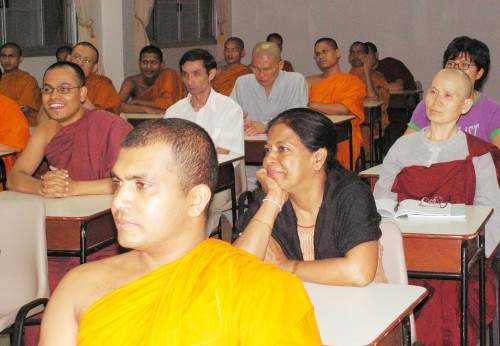
Guest Lecture Series at International Buddhist College


( IBC January 19, 2008 ) Every year, International Buddhist College receives many visitors from all over the world. Visiting practitioners, researchers and scholars share their experience in practice and research, and their findings with the faculty and students of IBC in series of lectures.
Heading the list of visiting scholars and researchers in 2008 is Mr Mattia Salvini. Mr Salvini is specialised in Buddhist Sanskrit literature. He is sharing with us his research findings in a series of lectures during his visit here at International Buddhist College. The topics he has covered so far include:
Guest Lecture I on Indian Buddhism: The lecture focused upon the possible sources for the study of Indian Buddhism, and discussed what we may mean by the term. In particular, it emphasized how a broader understanding of Buddhism may depend on sources other than just strictly canonical Buddhist texts. Works on secular branches of knowledge, non-Buddhist Indian philosophy, archaeology, epigraphy and also the living Buddhist traditions should be taken into due account.
Guest Lecture II on The Relation between Philosophy and Other Branches of Knowledge: Some Examples: Continuing the topic of the first lecture, the second meeting discussed some specific textual sources, especially in the context of the 'Five Sciences', a list of branches of knowledge, which form an integral part of the Bodhisattva path. As an example, a topic from the 'Science of Words' was analyzed in its relationship to the fundamental ideas of 'Self' and 'No-Self' in Vaibhãsika and Yogãcãra.
The two lectures were intellectually so stimulating that discussions and debates among the students continued for days after the lectures. In response to this enthusiasm in academic studies, Mr Salvini will continue to deliver more lectures. Coming up next is 'Yogãcãra'.
Another visiting Buddhist scholar is Associate Professor Bai Yuguo from Xiamen University of China. He gave a wonderfully comprehensive lecture on the state pf development of Buddhism in China in all its various aspects in recent times. What came through loud and clear is that there is a tremendous amount of spiritual quest and thirst that need to be addressed and met properly and systematically. In these regards, education of the sangha and the laity, especially all-rounded tertiary education is particularly important for Dhammaduta work to be effective in promoting Buddhism, Buddhist way of life and Buddhist ideals in China.