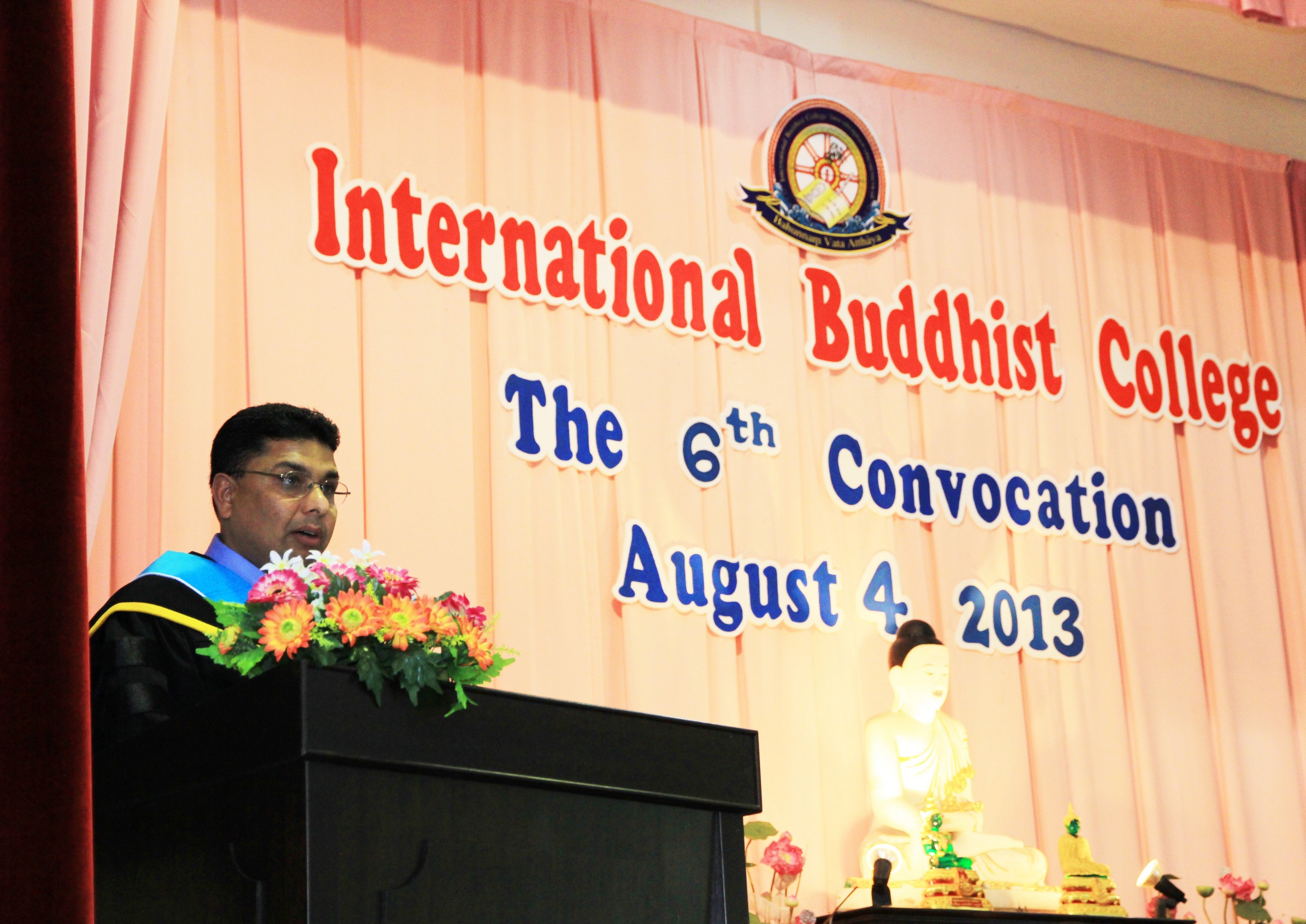
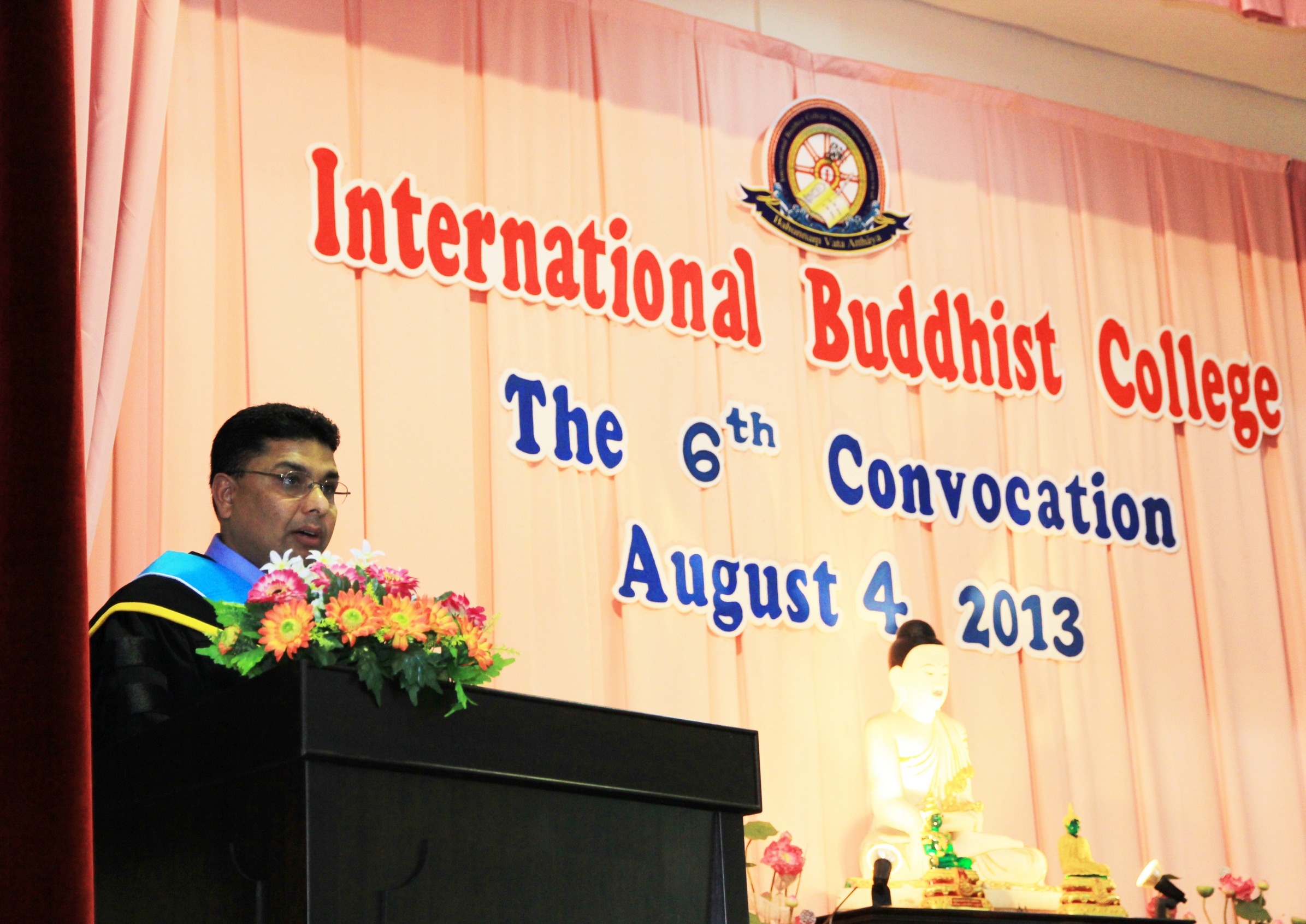
"Moral Framework (Dhamma) for Family Economics" - The Sixth Convocation Address (2013) by Prof. G.A. Somaratne


The Most Venerable Members of the Sangha,
The Chairman of the IBC Council; The Council Members;
The Rector; The Vice-Rector,
The Deans; The Directors; Professors; Staff;
New Graduates; Students;
Well-wishers; Ladies and Gentlemen!
I am humbly grateful to the Most Venerable Dr. Wei Wu, the Founder and the Council Chairman of the International Buddhist College (IBC) and the Dhamma Master of the Than Hsian Buddhist Temple for extending me the invitation to deliver this year’s convocation address at the 6th convocation of IBC at its main campus in Sadao, Songkla Province. I congratulate him and appreciate him for bringing IBC to a tremendously high standard in the fields of Buddhist studies within a very short period of its existence. Venerable monks, Venerable nuns, brothers and sisters, I congratulate you and rejoice with you in your merits today. The world is awaiting for you to teach dhamma, and it is now your duty to teach the world dhamma both in the form of rules of law, morality, ethics, and discipline and in the form of laws of nature, the truth, both soft dhamma and profound dhamma, both conventional rules and ultimate truth, and encourage people to practice dhamma (the rules of law) allowing dhamma (the laws of nature) effects peace in the world.1
I: Introduction
The Buddha’s teaching in the early Pāli discourses elucidates mainly the first dhamma: “how suffering comes to be and how it could be stopped”.2 It also describes comparatively a lesser set of instructions specifically directed to the laity, providing them with a family economic thought enshrined in a strong moral frame-work of lay disciplinary rules (gihi-vinaya, dhamma), that conforms to and are supportive of the laws of nature, the profound dhamma. In this address, I will discuss briefly the family economic thought as presented in the early discourses of the Buddha and practiced by the early lay Buddhist communities, and by so doing highlights the benefits of practicing the rules of law (dhamma) in conformity to the laws of nature (dhamma).
Economics generally deals with “individuals and organizations engaged in the production, exchange and consumption of goods and services”.3 The Buddha’s economic conception, however, deals with an employed householder who, by adhering to a code of ethics (dhamma), engages in production, protection and consumption, in a family setting, and as such it falls within the modern micro-economics.4 In this economic thought, such relevant concepts as family wealth,5 production,6 consumption,7 income and expenses (āyo ca vayo ca), making loans (iṇam ādāya), division of labor (su-saṃvihita-kammanta), investment (kammante payojeti), buying and selling8 and care work, more specifically child care and elder care9 are discussed appropriating them to the micro-economics of the householder. The main goal of this economic plan constitutes the family members’ (anto-jano) well-being (hita) and happiness (sukha) in this life (diṭṭha-dhamma) and in the next (samparāya).10
Its strong emphasis on the moral integrity of the producers and the consumers, its philosophical vision of interdependency of every phenomenon, situation, or event, and its subjecting all stakeholders to believe in a next life (para-loka) and in turn to accept that deliberately performed actions bear fruits (kamma) and that by means of energetic actions one can change one’s direction of life and living (viriya), and much more, make this economic plan unique. This linkage between economics (attha) and ethics (dhamma) instigates the Buddhist family to endeavor for the simultaneous achievement of the economic well-being and also the moral well-being, a healthy body and a healthy mind. The simile of “three men” found in a discourse elucidates this link: The first man is blind (andho) because he does not have either the eye of making effort in gaining wealth (bhogaṃ adhigaccheyya/phātiṃ kareyya) or the eye of understanding what is skillful and unskillful (kusalākusala-dhamme jāneyya), right and wrong, what is great and mean, and good and bad.11 The second man is one-eyed (eka-cakkhu) because he endeavors to progress economically but not so to progress morally. The third man is the ideal who has sight in both eyes (dvi-cakkhu). This last individual exercises his economic activities being himself situated within a strong moral framework (dhamma). The close link between economics and ethics is further evident from two sets of qualities given to a householder. The first set consisting four factors encourages the householder to make persistent effort in the production of wealth (uṭṭhāna-sampadā), to protect the produced wealth (ārakkha-sampadā), to associate with good friends (kalyāṇa-mittatā) and to live balancing one’s income and expenses (sama-jīvikatā).12 The second set concerns the practice of four moral values in him: confidence (saddhā), good conduct (sīla), generosity, (cāga) and wisdom (paññā).
II: Dhamma
Moral Framework
In this integrated ethic-economic plan, the ideal moral practice (dhamma-cariyā) expected of the lay converts (gihī-odāta-vasanā) generally consists of abstention from evil, performance of good, and purification of mind.13 This same practice, with a difference in the order, is presented in layman’s term as three ways of making merits: sharing (dāna), moral discipline (sīla), and the practice of meditation (bhāvanā).14 For the average laity whose goal is sensual enjoyment (gihī kāma-bhogī), the rightful fulfillment of the first two with some practice of the third constitutes “righteous conduct” (dhamma-cariyā, sama-cariyā).
Abstention from doing evil constitutes refraining from thoughts, words, and deeds that are conducive to self-harm, harm to others and of both. They are “unwholesome” (akusala), “demeritorious” (apuñña) and “evil” (pāpa).15 Destroying life, taking what is not given, engaging in sexual misconduct, telling lies, slandering, harsh speech, frivolous speech, intense desire, malice and wrong view constitute a popular list of ten abstentions.16 One who abstains from them has the luxury of enjoying the happiness of being blameless (anavajja-sukha) with regard to the conduct of body, speech and mind.17 Performance of good constitutes the actions known as “wholesome” (kusala) and “meritorious” (puñña), such as sharing one’s material wealth, teaching dhamma and caring for the elders, the actions that do “not conduce to self-harm, to the harm of others and of both”.18 The golden rule of ethics in the Buddha’s teaching is: “what is not pleasing and not dear to me is not pleasing and not dear to the other as well”.19
In this economic plan, as it is presented to the young man Sigāla, the family man avoids four bad actions (kamma-kilesā), namely, killing, stealing, sexual misconduct, and lying; four ways of partiality (pāpa-kamma-ṭṭhāna) arising from desire (chandā), hatred (dosā), fear (bhayā), and ignorance (mohā);20 six ways of dissipating wealth (bhogānaṃ apāya-mukhāni):21 addiction to drugs, sauntering in streets at untimely hours, frequenting degrading shows, gambling, associating with evil characters, and habitual idleness. Finally the family man, by fulfilling his duties, guards the six directions: parents (east), teachers (south), wife and children (west), friends and relatives (north), servants and employees (down), and religious teachers (up).
Right Livelihood
This economic plan falls within the practice of the middle way (majjhimā-paṭipadā), the noble eightfold path (ariyo aṭṭhaṅgiko maggo), that constitutes the practice of right view, right intention, right speech, right action, right livelihood, right effort, right mindfulness, and right concentration. In practice, the right view serves as the guiding principle for the practice of the other seven. Hence, the forerunner of practicing right livelihood is also the practice of right view.22 When practicing the right livelihood, one practices simultaneously three other factors: the right view, the right effort, and right mindfulness.23 For example, in choosing an occupation, one discriminates good occupations from bad ones, endeavors to find a good one, and finally decides the appropriate job mindfully.24 One can practice the right livelihood at one of two levels: mundane kammic level (puñña-bhāgiyā) or supra-mundane nibbānic level (lokuttarā).25 The lay follower often selects the first and practices it by avoiding wrong types of livelihood that conduce to self-harm and harm to other beings, such as trading in weapons (sattha), humans (satta), animals for meat (maṃsa), intoxicants (majja), and poisons (visa).26
III: Production
Family
The family concept that suits this economic thought most is the extended family (kula)27 where both the householder and his wife co-reside with their children (puttā, kula-kumāriyo), parents, and workers,28 while fulfilling some mutually beneficial duties towards each other. In this family concept, the family members, more specifically the householder, his wife and the workers, share the work inside the household. The householder is the family head (gaha-pati/kula-pati) and is the main income-generator by way of undertaking an occupation (kamma-ṭṭhāna) in agriculture (kasiyā), business (vaṇijjāya) or government service (rāja-porisena). He shares with his wife the role of altruistic headship in making family decisions for the benefit (anukampenti) of the family members (anto-jano).
This family concept with an extension to society is explained in the Sigālaka Sutta.29 The society has six constituents: parents, teachers, wife and children, friends and relatives, employees, and religious teachers.30 The family head has the simultaneous roles of son to parents, student to teachers, husband to wife, father to children, friend to friends, relative to relatives, employer to employees, and devotee to religious teachers. He is expected to fulfill his duties towards each and every constituent who in turn reciprocates (paccupaṭṭhitā … anukampanti). The natural benefit of the rightful fulfillment of duties towards each other is the creation of a binding family. The respective duties of each family member are explained enshrined in the four sources of treatments (saṅgaha-vatthu), namely, sharing (dāna), speaking pleasantly (peyya-vajja), working constructively (attha-cariyā), and treating each person equally (samānattatā).31 The four treatments are like four pins of a wheel axle.32 If the pins are lost or broken, the wheel comes loose from the axle. Analogously, as long as the four treatments are practiced, the family and in turn the society could enjoy economic prosperity and moral happiness for a long time.
Persistent Effort
A good family economy implies the availability of a sufficient wealth. The householder who is responsible for providing facilities for the family members (anto janassa) and dependents (anujīvino) is also responsible for earning this wealth.33 It is this production aspect that is identified as “persistent effort” (uṭṭhāna-viriya, uṭṭhāna-samapadā) of the householder. “By whatsoever work (kamma-ṭṭhāna) a householder earns his living – whether by farming, by trading, by cattle herding, by archery, by government service, or any other kind of craft – at that he becomes skillful (dakkha) and is not lazy (analasa). He is endowed with the power of discernment (vīmaṃsā) as to the proper ways and means (upāya); he is able to carry out his allocated duties (kātuṃ … saṃvidhātuṃ). This is called persistent effort”.34
The work is an opportunity to cultivate good qualities within; every good deed practiced benefiting others enriches the person morally. The present good work lays a foundation for the performance of future good works. The law of cause and effect (kamma) does not operate as a destiny. The individual is free to make changes to the process, and in turn to his life through effort. A good work is measured by considering to what extent both the doer and the society could benefit from it. Hence, the householder avoids such jobs that bring destruction to animals, human beings or natural resources. Repeated and righteous endeavor in one’s work helps produce a sufficient wealth. However, earning a good income by righteous means is not easy. In this connection, the Dhammapada says, “Life is lived with difficulty by him who is modest, who always seeks the pure, who is unclinging and unboastful and whose living is clean”.35 On the other hand, it is easy to lead a shameful life “with skills of a crow”.36 However, what is praiseworthy and morally correct is the righteous living. If a person who did wrong recognizes and admits that he did wrong and corrects himself, that person had made progress.37 Contemplation on the mistakes of one’s own and of others from time to time may help avoid making similar mistakes again.38
Protection
The protection of one’s wealth by righteous means is as important as the production of wealth. A discourse defines it as follows: “Herein … whatsoever wealth a householder is in possession of, obtained by effort, justly acquired by righteous means – such he husbands well by guarding and watching so that the government would not confiscate it, thieves would not steal, the fire would not burn, flood would not carry away, nor ill disposed heirs remove. This is the protection of one’s earning”.39 The wise householder avoids risks in the production and maintenance of his wealth, the causes that make the family economy decline such as: to pay no attention to what is lost, not to repair what is damaged, to know no moderation in one’s lifestyle and to give authority (ādhipacca) to a male or female waster to run the household affairs.40 If the householder identifies and pays attention to what is lost and damaged, and practices moderation in consumption, that helps save wealth and balance the family budget. Neglect of the protection aspect put’s one’s effort in the production in vain.
Happiness of Production
An economically successful family has the benefit of experiencing several schemes of happiness. One relevant here presents four types: happiness caused by possessing sufficient wealth earned honestly (atthi-sukha), happiness produced by being able to spend that wealth in ways that benefit to the whole family and beyond (bhoga-sukha), happiness caused by being free from debts (anaṇa-sukha), and happiness caused by blameless conduct (anavajja-sukha) of the family members.41 The wise householder who earns a sufficient wealth energetically (uṭṭhāna-viriyādhigatehi) and righteously (dhammikehi)42 enjoys the first happiness. Though there are numerous ways one could gain wealth, he selects only those that come within the moral framework of abstention from evil and performance of good for he knows the law of dhamma that one could enjoy the happiness of self-sufficiency of wealth, only if that wealth were to have acquired by righteous means (dhamma-laddha).
Trading
A sizable number of instructions on family economy are concerned with the things to be done and not to be done by a good businessman. For example, the traders (pāpaṇika) who work towards obtaining new wealth or multiplying his profit are advised to keep strict attention to their business (sakkaccaṃ kammantaṃ adhiṭṭhāti) in all four periods of the day — in the morning, at noon, in the afternoon, in the evening.43 This advice exemplifies the general dictum that one must do one’s work well in the beginning, well in the middle, and well in the end.
The businessman who expects to make his business progress (mahantattaṃ vā vepullattaṃ vā pāpuṇāti bhogesu) should cultivate some qualities: he should have clear knowledge (cakkhumā), be clever (vidhūro) and have a good reputation (nissaya-sampanno). To know the value of goods (paṇiyaṃ) is what is meant by good knowledge. Profit is possible if one buys goods less than the price at which he can sell them.44 At the same time, the businessman should be skillful in buying, measuring and marketing,45 and be friendly with bankers and other businessmen. Thus he builds a good reputation and inspires confidence in his character and his business. If the other businessmen have confidence in him, they will not hesitate to lend him money and wealth at times of his downfall.46
Happiness of the Debtless
Freedom from debts is another happiness that the householder could enjoy. However, it could be enjoyed only by those who use their robust strength, vigor and energy to make their investments productive and profitable. Making loans for investment is not opposed, but excessive borrowing for any purpose is discouraged. Those who do not repay their debts, especially those who have the ability to do so are severely criticized. For the Buddha, those persons who do not try to pay back their debts and who even deny that they have borrowed at all are the “outcaste” (vasalo). To gain the happiness of being free from debts, the wise borrower invests carefully the wealth that he borrows. It is said that if a person wastes the money he borrows, he will “dig his roots himself”.47 On the other hand, if a person invests borrowed money properly, he is destined to have the joy that comes from having contracted a loan and having set a business on its feet, and developed it successfully to the point that he is able to pay off all his debts, and support his family and children from the savings he managed to put aside.48
Idleness
By being constantly active, watchful and accurate, the householder can produce a sufficient wealth to maintain a good economy. Idleness is a harmful quality for both economic and moral success. In his discourse to Sigāla, some perils of idleness are identified: A man says, it is too cold, and does no work. He says, it is too hot, and does no work. He says, it is too early and does no work. He says, it is too late, and does no work. He says, I am too hungry, and does no work. He says, I am too full, and does no work. And while all that he should do remain undone, he makes no money, and even the wealth he already has dwindles away.49 This discourse needs no more explanations.
Employer and Employee
A good relationship between the employer and his employees processes a good production. Good management (susaṃvihita-kammanta) depends on mutual support from both parties. Each has his own duties and responsibilities to fulfill and certain rights to be honored. The good employer builds confidence among employees by apportioning work wisely among them appropriate to their skills and strengths, providing them with food and wages, tending them in sickness, sharing special benefits with them, and giving them rest and holidays at proper times.50 It is in the duty of the employer to manage his business properly. Proper management helps the employees to work confidently both physically and mentally. No one would like to work in a confused place. The clever employer understands the respective abilities and skills of his employees and appoints them for specific positions accordingly. Persons who lack abilities in certain jobs would get into serious difficulty if the employer were to assign them to do. Such bad apportioning would have bad effects in production. The wise employer provides adequate wages to the employees and shares from time to time his profits by giving them bonuses. In case of the employees’ sickness, he takes special care of them by providing medical assistance. Employees who enjoy the benefits of their employment with the goodwill of the employer reciprocate that good will by dutiful and pleasing service. This is the way of dhamma.
To come to work early and to complete the day’s work carefully and earnestly are the two most important duties of employees.51 In the discourse to Sigāla, some duties of the employee are listed. The employee rises before the master rises, that is, he comes to work on time. He goes to sleep after the master, that is, he works the full length of his shift. He takes only what the employer gives. He completes his work well and speaks well about the employer and the workplace. Stealing includes taking property dishonestly and also wasting time and energy. If the employee expects his salary without doing sufficient work, or if the employer does not pay sufficient wages for the actual performance of the employee, both are stealing from or cheating each other. According to the dhamma way, cheating cannot produce confidence and peace.
IV: Consumption
Happiness of Consumption
The householder gains wealth for the purpose of using it for one’s own and to give to others by way of fulfilling one’s family and social duties. 52 He derives happiness from allocating wealth for use benefiting family and society. By supporting the family members, he enables them to live in comfort. Further, he shares his wealth with friends securing his family against all misfortunes (āpadā), supports his relatives, receives guests, performs religious and social activities, and pays taxes to the government (rāja-bali).53 In brief, the good householder who uses his wealth to meet the needs of him, his family and his community is happy.54
Woman’s Role
In this economic system, the woman serves the family playing different roles: householder’s wife, mother of children, and the house-manager under whom servants and workers serve. Most importantly, she takes the responsibility of managing the family wealth earned by her husband, and using it for the benefit of the whole family. She is the one who assigns the tasks and makes payments to the servants and workers.55 The woman’s supremacy in the household affairs is further evident from the fact that most of her duties towards her husband (sāmika) are appropriated in the proper management of the household. One important duty of the householder is to hand over the authority of the family wealth (issariya-vossaggena) to his wife (bhariyā).56 She in return is expected to perform her household duties earnestly, being hospitable to her husband’s relatives, remaining strictly faithful to her husband, protecting his earnings and being skillful and industrious in all her affairs.57 Her powerful place within the family is further strengthened through her good conduct.58 All heroes, leaders and even kings are born to women.59 As mother, the woman teaches and guides children on a path to becoming good citizens. The children who are being raised properly will repeat the same when they become parents, creating the continuation of the family line (kula-vaṃsa). In the ideal family, the parents dissuade their children from what is bad, persuade them to do good, educate them properly, get them married at an appropriate age and hand over an inheritance (dāyajja) at a right time.60
Balanced Livelihood
The proper use of one’s earned wealth is introduced with a new economic concept of balanced livelihood (sama-jīvikatā) and is defined in a text as follows: “one, knowing his income (āya) and expenses (vaya), leads a balanced life (samaṃ jīvikaṃ), neither extravagant (atigāḷha) nor miserly (atihīna), knowing that thus his income will stand in excess of his expenses, but not his expenses of his income.”61 This person is compared to a man who, holding up a scale, weighs, knows by how much it will tilt up (ettakena vā onataṃ ettakena vā unnataṃ).62 Further, one’s spending should be reasonable and appropriate to his income, neither too much nor too little. If a person with little income (appāyo) were to lead an extravagant life (uḷāraṃ jīvikaṃ), rumor would say of him, “This person eats wealth like those who eat the fruit of a glamorous fig tree” (udumbara-khādikaṃ), and if a person with a large income (mahāyo) were to lead a wretched life (kasiraṃ jīvikaṃ), rumor would say of him, “This person will die like a starveling” (ajaddhumārikaṃ). Balanced livelihood thus is a middle way of consumption, and as such it avoids extremes of miserliness on the one hand and extravagant life on the other. Life lived following the middle way should be simple, moderate, and with an easily controllable budget. The more one’s earning is exceeded by spending, the more the difficulties one has to face. That is the rule.
Saving
This family economic thought, however, does not encourage the householder to consume everything he earns. In detailing this, the householder is advised to divide his income into four portions: only one portion out of the four is to be used for one’s day-to-day living expenses such as buying daily bread and providing other necessities for the family (bhuñjeyya). Two portions are to be used for the stability and progress of his business (kammaṃ payojaye). This could include paying wages to his employees and buying the raw materials required for running his business. The remaining portion is to be saved (nidhāpeyya) for use in case of natural and other kinds of disasters and tragedies (āpadāsu).63
Saving wealth is not possible for the morally wrong doers. Addiction to womanizing, alcohol and drugs, and gambling, and also having friendship, companionship, and intimacy with evil doers are among the sources for the destruction of amassed wealth (apāya-mukhāni)64 that force to consuming everything the householder earns. The wastrel as he can expect only the decrease of wealth, for it is like a man who closes the four inlets and opens the four outlets of a big water tank that has also no adequate rainfall, can expect only the decrease of the water of the tank, not the increase. On the other hand, abstinence from these sources conditions increase of wealth. Just as the person who opens four inlets and closes the four outlets of a water tank which has adequate rainfall can expect the increase of water in the tank, not its decrease, the person who avoids those ill practices can expect a gradual increase of his wealth. Addiction to alcohol and drugs wastes one’s health, wealth, happiness, and good name.65 One addicted to alcohol and drugs, says the Buddha, would confront an actual loss of wealth, an increase in quarrels, a susceptibility to disease, an evil reputation, indecent exposure, and the ruining of one’s intelligence. Similarly, one addicted to sauntering in streets at unseemly hours would be unprotected and unguarded, not to mention his wife, children, and property. He becomes subject to suspicion and false allegations with respect to evil deeds. He is also likely to be beset with misfortune.66
Needs and Greed
Essential consumption is not a waste; rather it is the purpose of earning wealth. Hoarding food and wealth is condemned strongly.67 One should save only for use in need, not for miserly collecting. To save more than one will need is a kind of waste. Similarly, to spend more than one’s need is also a kind of waste. The highest limit of earning wealth depends on contentment (santuṭṭhi). As a scholar puts it, “we can satisfy only our need, not our greed”. If our aim is to satisfy our greed, then resources in the world are limited, but we got enough if our aim is to satisfy our needs.68 Greed conditions many ills in the world. The law of dhamma on this works as follows: The more one craves the more one searches; the more one searches the more one gains; the more one gains the more one makes judgments; the more one judges the more one wants; the more one wants the more one tries to get; the more one tries to get the more one acquires; the more one acquires the more one becomes selfish; the more selfish one becomes the more one needs security; to satisfy one’s need for security one has to keep weapons and this conditions quarrels and various evil deeds.69 Clothes, food, housing, medicine, and some utensils70 are considered as one’s basic needs but the pursuit of those when driven by excessive greed, humans go against other humans. According to the law of dhamma, one cannot find enough satisfaction in sleeping, taking intoxicants or having sex. The more one engages in them, the more one wants.71 Craving is like a blazing fire. It burns every fuel in whatever amount one puts in. The worldly people are slaves of craving.72 Hence the wise householder is expected to identify the basic needs and earn a sufficient wealth to satisfy them with some limits.
Over-consumption affects health. Those who eat more than they require as well those who eat much below the level of their earnings for hoarding wealth are sick. Only moderate consumption can make healthy people. This is illustrated in a story concerning King Pasenadi of Kosala.73 The king at that time ate a large amount of cooked rice. Once he came to the Buddha after his lunch, breathing heavily. The Buddha, seeing the king was breathing heavily said, if a man is always mindful, and knows moderation in the food he takes, his pains diminish, and the food is digested slowly, preserving his longevity.74 Since then the king made him recollect this statement during his meals. Then he gradually restricted himself, taking one cupful of rice at the most. On a later occasion, with his body well slimmed, stroking his body, the king said: Buddha has indeed shown his compassion towards me in both ways, for this world and the next.
Good Friends
The householder should have good friends and the good friends are part of the family economic plan. Good friends are possible for those who cultivate good qualities such as confidence, virtue, charity and wisdom. One who possesses them would be able to act with the confidence of the confident, with the virtue of the virtuous, with the charity of the charitable and with the wisdom of the wise.75 The good friends share their time, energy, skills, knowledge and wealth with each other. It is this cooperative and sincere attitude towards each other that makes good friendship possible.76 Real friends are an asset to the householder because they support and protect him when in need; particularly when the householder is heedless, they extend their protection to householder’s family members, relatives and friends.77 The helper – anyone who is the same in happiness and adversity, who gives good counsel and who sympathizes – is a good friend type. The intelligent householder avoids foes in the guise of friends. The rapacious person, the person who renders lip service, the flatterer and the wastrel all belong to this category.
V: Government
Poverty and Social Disorder
Government’s responsibility with reference to family economy cannot be neglected. Poverty and social disorder in the country affect the economy of the households. These two issues are interrelated and interdependent. Social disorder occurs because of poverty, and vice versa. Both may occur due to a decline in the practice of moral values. One discourse identifies the leading cause for social disorder to be the lack of distribution of wealth and resources for the needy. In that society poverty grew rife because of resources not being distributed well. When poverty grew rife, people started to steal; then the production and the use of weapons increased. This resulted in an increase of violence and murder. With this, lying, evil speech, adultery, abusive and idle talk increased. Then covetousness and ill will, false opinions, incest, wanton greed, perverted lust, and hundreds of other evils started to increase.78
Then what are the solutions presented for the elimination of poverty and social disorder? A discourse gives us an account of how the king Mahāvijita, having accepted the instructions of his advisor, eradicated crimes by implementing a plan that would successfully eliminate poverty and, as a result, social disorder. The main program of the king consisted of the king provided grains and other agricultural facilities for the farmers and planters; he provided capital for traders and businessmen, and he also provided adequate wages for government servants.79 According to the discourse, after having jobs to do the people of that society followed their own business. They did not harass the country any more. Gradually the government’s revenue increased, and the country became peaceful again. The discourse states further that the population was so pleased that they danced their children in their arms. They dwelt with open doors.80
Because natural resources are limited, it is the duty of the government to see the equal and adequate distribution of these resources among its people. Otherwise the greedy will exploit the natural resources for their own advantage. The actions of the greedy push the needy into an increasingly desperate poverty. In brief, as one scholar said, one person’s need may be stolen by another person’s greed. Elimination of greed cannot be done solely by implementing the man-made law and its punishments. It must be accompanied by a programme to improve ethical and social values of the people.
VI: Conclusion
In this address, we saw several intrinsically interrelated, interactive, and interdependent aspects and areas of family economics that demand singly or collectively that its stakeholders strictly adhere to the ethical and moral norms (dhamma) laid down by the Buddha if they are to achieve the expected material well-being and moral happiness while winning as lay people both this world and the next world. The ethical framework (dhamma) of this family economic plan has the respect for the rights of all living beings to live and make a living, as its foundation. As such, it invites its stakeholders to adjust their lifestyles and economic goals to the norm of “moderation” while practicing the rules of law and discipline (dhamma) that are grounded on such universally accepted good principles (dhamma) as simplicity, truthfulness, nonviolence, friendship, compassion, social justice, and equality.
References:
The Pāli canonical texts referred to are of the Pāli Text Society, London.
DN = Dīghanikāya, 3 volumes
MN = Majjhimanikāya, 3 volumes
SN = Saṃyuttanikāya, 5 volumes
AN = Aṅguttaranikāya, 5 volumes
Bibliography
- Alexandrin, Glen. 1981. “Buddhist Economics: An economics of the middle way.” Gandhi Marg. 2 (ii): 627-37.
- Alexandrin, G. and Alexandrin, B. 1979. “Towards a Buddhist Economics.” Zero, vol. II. Los Angeles: Zero Press.
- Ariyaratne, A.T. 1978. A Struggle to Awaken. Colombo: Sarvodaya Shramadana Movement.
- Aronson, Harvey B. 1980. Love and Sympathy in Theravada Buddhism. Delhi: Motilal Banarsidas.
- Balkrishna, Govinda Gokhale. 1987. “The Concept of Disorder in Early Buddhist Political Thought.” Sri Lanka Journal of Buddhist Studies. 1:129-138.
- Basham, A.L. 1958. “Society and State in Theravada Buddhism.” Sources of Indian Tradition. Ed. William T. de Barry. Columbia University Press. 127-53.
- Benz, Earnest. 1965. Buddhism or Communism: Which holds the future of Asia. Tr. from German by Richard and Clara Winston. New York: Doubleday and Co.
- Coombs, Philip H., ed. 1980. Meeting the Basic Needs of the Rural Poor: The Integrated Community-based Approach. New York: Pergamon Press.
- Dutt, Nalinaksha. 1945. “The Place of the Laity in Early Buddhism.” The Indian Historical Quarterly. 21:163-83.
- Endo, Toshiichi. 1987. Dāna: The Development of its Concept and Practice. Colombo.
- Gard, Richard. 1962. “Buddhism and Political Power.” The Ethics of Power. Ed. by Harold D. Lasswell and Harlan Cleveland. New York: Harper and Bros. 38-70.
- Gnanarama, P. 1998. Aspects of Early Buddhist Sociological Thought. Singapore.
- Gombrich, Richard F. 1971. Precept and Practice, Traditional Buddhism in Rural Highlands of Ceylon. Oxford: Clarendon Press.
- Green, Ronand M. 1990. “Buddhist Economic Ethics: A Theoretical Approach.” Ethics, Wealth and Salavation, ed. Russell E. Sizemore and Donald K. Swearer. Columbia Press.
- Greg, Richard B. 1958. A Philosophy of Indian Economic Development. Ahmedabad: Navijivan Pub. House.
- Harrison Brown. 1954. The Challenge of Man’s Future. New York: The Viking Press.
- Horner, Isaline Blew. 1970. Women under Primitive Buddhism. New York: E.P. Dutton.
- Jayatilleke, K.N. 1962. Buddhism and Peace. Kandy: Buddhist Publication Society.
- Kantowsky, D. 1980. Sarvodaya: The Other Development. New Delhi: Vikas Publishing House.
- Karunatilake, H.N.S. 1976. This Confused Society. Colombo: Buddhist Information Centre.
- Keown, Damien. 1996. The Nature of Buddhist Ethics. Besingstoke.
- Kumarappa. 1958. Economy of Permanence. Rajghat, Kashi: Sarva SEva Sangh Pub.
- Macy, Joanna. 1985. Dharma and Development: Religion as Resource in the Sarvodaya Self-help Movement. Connecticut: Kumarian Press.
- Payutto, P.A. 2007. A Constitution for Living. Kandy: Buddhist Publication Society.
- Rahula, Walpola. 1974. What the Buddha Taught. New York: Grove Press Inc.
- Saddhatissa, H. 1972. “The Buddhist Attitude to the Food Problem.” Mahabodhi. 80 (5-6): 247-9.
- Saddhatissa, H. 1970. Buddhist Ethics: Essence of Buddhism. London.
- Schumacher, E.F. 1973. Small is Beautiful as if People Mattered. New York: Harper and Row Publishers.
- Silva, Padmasiri de N. D. The Search for Buddhist Economics. Kandy: Buddhist Publication Society.
- Silva, Padmasiri de N.D. Value Orientation and Nation Building. Colombo: Lake House.
- Tambiah, Stanley J. 1973. “Buddhism and the Worldly Activity.” Modern Asian Studies. 1:7
- Tennekoon, Serena. 1981. Buddhist Involvement in a Changing Society. Colombo: Marga Institute, Sri Lanka Centre.