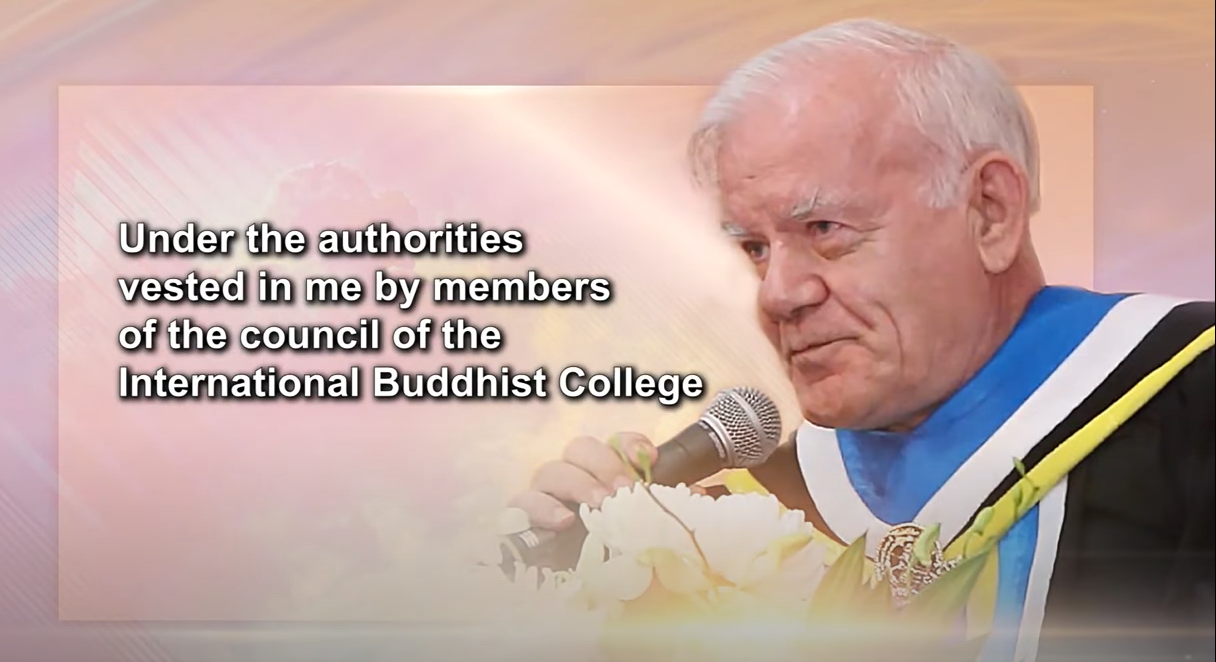
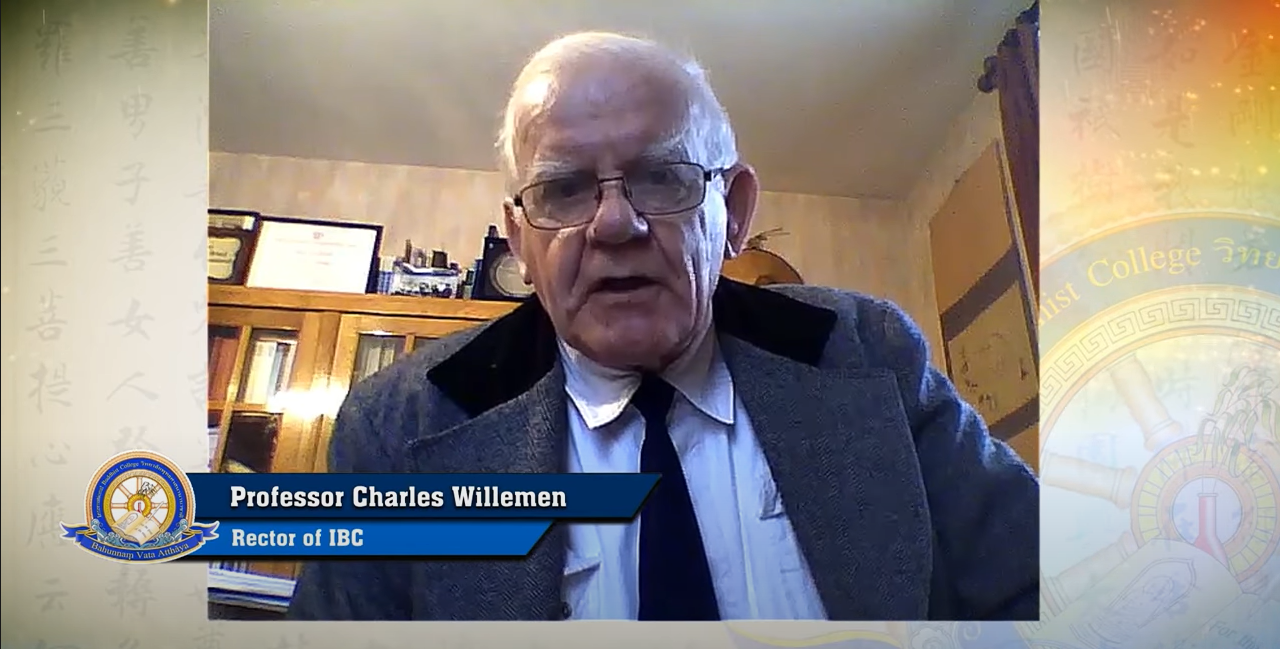
14th IBC Convocation Speech by Professor Charles Willemen, the Rector of IBC


Dear Scholars,
For quite some time I have been considering how to best address you. Finally, I have decided on “dear scholars”. This address contains two words, which are equally important, relevant.
Dear means that people in general and also I see you as precious individuals. You are all very precious to me. That is my emotional reaction to you. Dear has to do with emotion.
The word scholar is intellectual. One may be a good scholar, but absolutely not dear, and vice versa. So, this address appeals both to the feelings and to the intellectual brain, to the mind.
We are in a College, in an institution where one learns, where one advances intellectually. The field in which one mentally advances is called Buddhology. It is wider than the four noble truths and the twelve links of the chain of dependent origination, pratītyasamutpāda. It is the study of the Dharma, the law, theory, and of the Vinaya, the rules to live by in a community of nuns and monks.
As your instructor I am supposed to know more than you about these two subjects. We will explain the law, the rules of Buddhism, both in a historical and in a contemporary context.
Different cultural areas in the world have a different understanding about this, because different cultural areas in the world have a different culture, a different context and background. A Chinese and an Indian start from a different context, but the goal always is to intellectually advance, to know more about the views of a Buddhist, whatever her or his background. Gender plays a role. It is obvious that the two genders are physically different. So, the solution to their problems may be different too.
There is no value judgement in my words. The first noble truth, that there is suffering, is true for everyone. We will explain how the dharma is applied in a different culture. Indian Buddhism and Chinese Buddhism, although they have the same goal, namely perfect rest, still have different ways. They put greater stress on different subjects. It is quite important to develop a sense of relativity.
The study of languages is important too. One should be aware of the meaning of technical terms, in more than one language. Nirvāṇa is now known as “perfect rest”, but different explanations have been given in the past. So, the technical terminology must be explained in different languages, without any misunderstanding.
In a College we may explain the rules of the Vinaya, but the dharma is more challenging to explain. The Vinaya is and always was quite clear, especially for monastics. Instruction in the dharma is more challenging. There are different kinds of Buddhism, different schools, putting the stress on different fields. In India a school is defined by its Vinaya, but in China intellectual differences do matter a great deal more. Everyone can understand that an intellectual may prefer Chan or Zen. Being intellectual is an obstruction to perfect rest. One may think too much. Pura Land Buddhism, a Sino – Japanese form of Buddhism, is meant for another public.
I will not start comparing Buddhism with any other religion, because in order to compare one has to know the compared fields quite well.
I will limit myself to Buddhism. So, the word scholar, being intellectual, is what matters most in a College. But, as there are different cultures involved, a clear explanation is necessary. The Buddha Himself has considered confusion and ignorance the worst affliction of all. Also, I do not mean to say that the more you know, the better Buddhist you are.
I will offer insights, but you yourself have to apply what is useful for you. The degree in which one may apply knowledge depends on your nature, of course. So, dear scholars, I will offer you knowledge, but how you apply that knowledge will be different for every individual.
May the Buddhadharma prosper in the world.
Date: 5-9-2021