
Assoc. Professor Dr. Mattia Salvini: The four types of prajñā


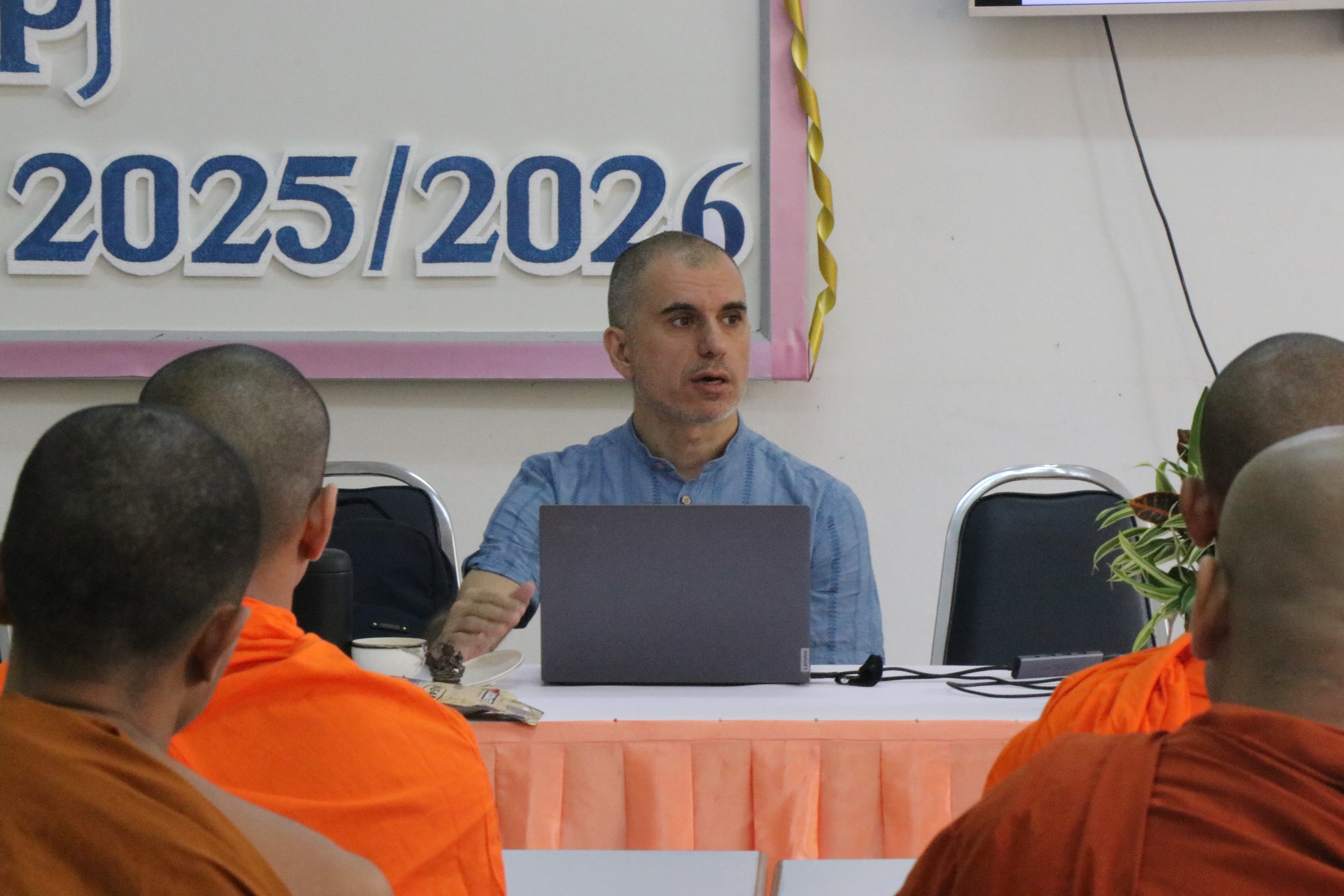
There are different ways in which the Buddhist traditions approach the integration of learning and meditative practice. One often-cited scheme is that of different types of prajñā, most commonly listed as three, and occasionally as four.
The word prajñā is commonly translated as “wisdom” by extending the English focus of the term—which, one could argue, primarily refers to knowing what to do. Prajñā has a broader scope, and its main emphasis is often on knowing the nature of reality. The term is formed from the root jñā, which has the sense of knowing/understanding/being aware of. This is preceded by the upasarga pra-, which is sometimes interpreted as meaning prakr̥ṣṭa, i.e. excellent, elevated. Prajñā is a type of elevated, superior, “knowing” or “awareness”.
In the presentation of the three Buddhist trainings of discipline (śīla), mental equipoise (samādhi), and wisdom (prajñā), it is clear that prajñā refers primarily to the realization of the nature of reality; it is here a synonym of discerning things (dharma-pravicaya), and even of vipaśyanā.
Sustained by the trainings in discipline and samādhi, wisdom is presented as a three-step process: wisdom consisting of listening (śrutamayī prajñā), wisdom consisting of contemplation (cintāmayī prajñā) and wisdom consisting of meditation (bhāvanāmayī prajñā).
The first type of wisdom is acquired by listening to the teachings and avoiding three flaws, exemplified by: a pot upside down (not paying attention), a pot containing poison (having wrong motivations while listening), and a pot with holes (not being able to retain anything). Please note that the emphasis is on listening, which highlights the interactive nature of Buddhist learning. A text is primarily meant to be learnt by listening to a teacher; it is not a self-sufficient entity for private consumption. The emphasis on sound, which is enacted and cultivated by chanting the texts (they are composed so as to be chanted), allows one to cultivate the type of mnemonic integration that prevents the third pitfall and offers a natural bridge towards both reflection and meditation.
The second type of wisdom is the result of reflecting on the teachings that one has heard and striving toward a definitive ascertainment (niścaya) of their meaning. This moment of ascertainment is regarded as crucial, as it means that the fundamental basis on which to meditate has been established and can be cultivated with increasing levels of one-pointedness and vividness.
This brings us to the third type of wisdom. When meditation on the nature of reality reaches its culmination, one obtains the type of non-conceptual awareness which is sometimes called jñāna as distinguished from vijñāna. When it is taught that one should rely on awareness and not on consciousness, it refers to this distinction. Consciousness is the perception of objects (including mental objects), while awareness is the realization of the nature of things (the dharmatā, the two types of selflessness). This realization of selflessness is the most direct cause for mental purification and freedom from saṁsāra.
The fourth type of wisdom is that which is obtained at birth (upapattipratilambhikā). Since Buddhist practice is always understood within the framework of multiple lifetimes, this category of wisdom is a helpful reminder of that broader context. Even if a person has limited wisdom in this lifetime, engaging with the teachings and, especially, accumulating merit during this lifetime will be helpful in the future.
It should be quite obvious that this scheme does not fit very naturally into a contemporary academic setting, which was formed in a completely different tradition and according to completely different concerns and presuppositions. For example, Buddhist Studies as an academic field relies on a very well-defined type of evidence-based argumentation, wherein only specific forms of evidence (mostly, if not entirely, outer) are relevant, and wherein an author forms hypotheses that are by their very nature always tentative and modifiable according to new evidence (of the same type): there is no question of coming to an ascertainment of the nature of reality—let alone meditating on it, or considering effects on future lifetimes. The type of knowledge that is constructed and transmitted through academic writing is tentative and constrained by very specific views on evidence and its interpretation; it is part of a very distinctive intellectual endeavor that has little or no parallel in a Buddhist context (that I know of, at least).
For Buddhists who are studying Buddhism in a contemporary academic setting, this poses practical challenges. Our interest may be in obtaining prajñā in a Buddhist sense, yet the very structure of a university is geared towards regarding that aspiration as irrelevant or even naïve. It is therefore important to understand that there is a vast gap between the two types of literature that we will encounter: primary Buddhist texts are composed in order to make it possible to eventually realize the nature of reality, while modern academic literature on Buddhism is composed for completely different purposes – this is also reflected in their respective formats and styles, which are hardly comparable. Once we understand this distinction, we can begin to navigate the confusing experience of learning Buddhism from such discordant voices and we may find a way to address our own concerns and aspirations skillfully. To do so, it is best not to neglect traditional Buddhist formats of learning, such as chanting sūtras and śāstras in their original Buddhist languages.