
Buddhism and attention: Reflections for our new students


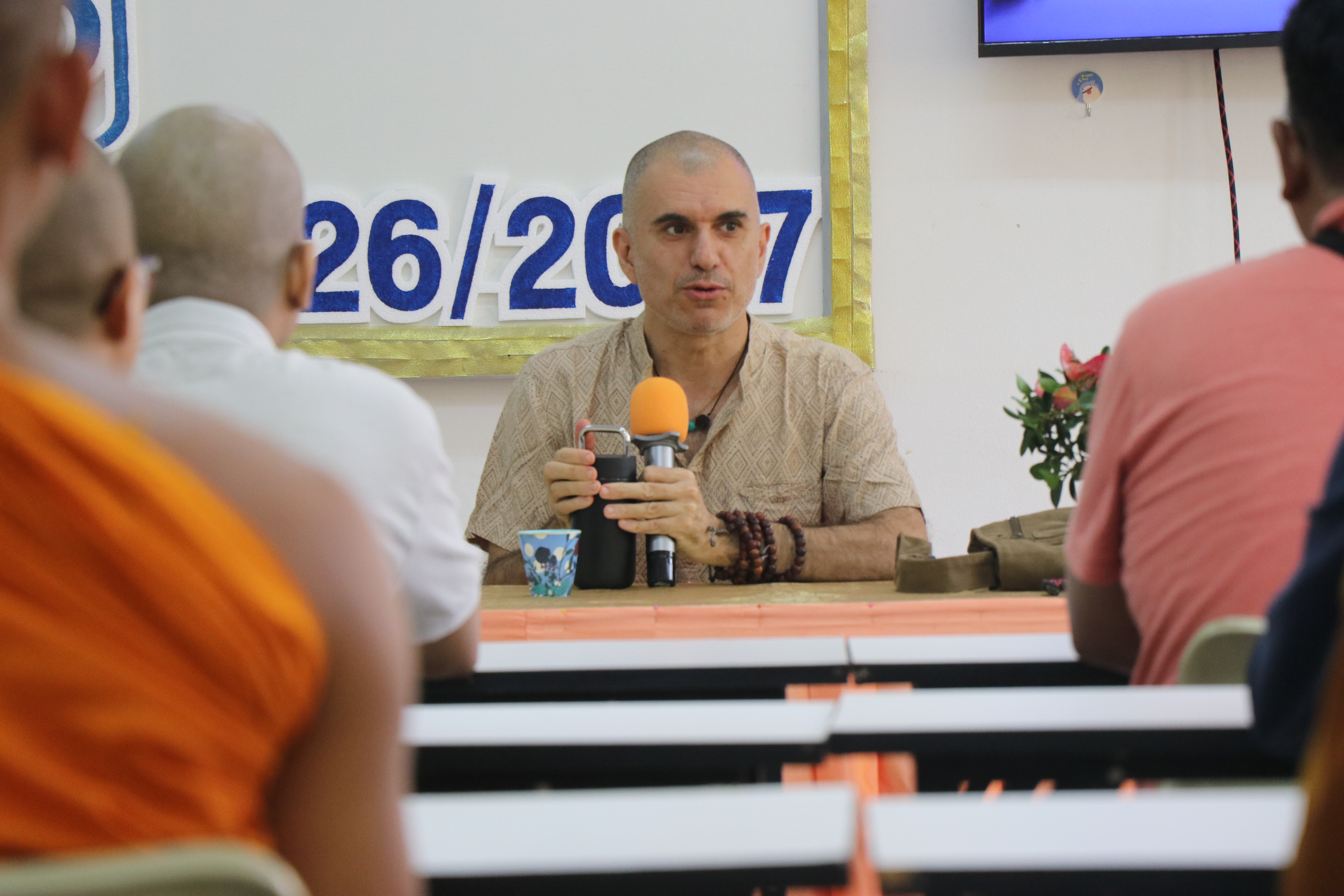
Dharmavardhana-Jñānagarbha
अविकल्पितसंकल्प
अप्रतिष्ठितमानस ।
अस्मृत्यमनसीकार
निरालम्ब नमो ऽस्तु ते ॥
avikalpitasaṃkalpa
apratiṣṭhitamānasa |
asmṛty amanasīkāra
nirālamba namo 'stu te ||
With no conceptualized construct,
With a non-placed mind,
Without mindfulness, without placing in the mind,
Supportless, homage to you!
Mañjuśrī’s Praise of Buddha Śākyamuni, from
The Ornament of the Light of Awareness Sūtra, Jñānālokālaṁkārasūtra
The idea of attention relates to several different Buddhist key terms, pertaining to different aspects of the Buddhist path. The ability to pay attention is also a recurrent topic of discussion in the context of learning and teaching in general, and even basic mental health. I will briefly discuss a selection of Buddhist terms that I believe may be helpful in fostering a more conducive and meaningful classroom experience.
One of the Sanskrit terms most frequently rendered by the English word “attention” is manasikāra/manaskāra. A rather literal rendering could be something along the lines of “placing in the mind”. This idea appears frequently in the initial sections of the Sūtras, where the Buddha opens his teaching session with an invitation to pay attention:
tac chruṇuta sādhu ca suṣṭhu ca manasikuruta bhāṣiṣye
Listen properly and place it well in your mind; I am going to speak.
This statement is explained by commentators (such as Vīryaśrīdatta, who composed a commentary on the Arthaviniścayadharmaparyāya, the Sūtra from which the above sentence is quoted) as encouraging the monks to avoid the three defects of the pot: if a pot is upside down, water will not even enter; if a pot has holes, it will not stay for long; if a pot is poisoned, the water that it collects will become harmful.
This passage offers a helpful template to enhance one’s learning experience even in the context of a contemporary classroom. Students (and even lecturers) not rarely struggle with continuous focus on a single task/object of attention (in Buddhist terms, a “support”, ālambana, i.e. a cognitive object). Most Buddhist traditions I know of would agree that it is not quite possible to simply wish away distraction by an initial resolution to have perfect one-pointed concentration – say, at the beginning of a lecture. It is rather to be expected that the mind will wander; but there is a crucial difference between starting with a wish to pay attention vs starting with the clear intention to think of anything else except what the lecturer is saying – to engage in other activities, such as games, drawing, internal storytelling, kicking a classmate, etc., that require a precise intention to not pay attention.
I personally feel that this makes an enormous difference. When students are encouraged to pay attention, it is not with the expectation that they will have the ability to enter a sort of samādhi on the speech of the lecturer. Indeed, even if this could at all be possible, it might even be undesirable – it may be an excessively focused type of concentration that would prevent conceptual engagement with the content of the lecture. Thus, some wandering of the mind is to be expected, but not intentionally encouraged and cultivated. In this way, even a boring lecture may become an occasion to learn something: how to cultivate attention, and how to be patient with a manageable level of discomfort (such as boredom, which is arguably an important experience for any learner).
The passage from the Arthaviniścaya is related to the more specific concept of “proper mental placement”, yoniśo manasikāra. As it is said in the Ekottarāgama:
There are two causes, two conditions, for the arising of right view: voice, from someone else, and, within oneself, proper mental placement.
dve hetū dvau pratyayau samyagdṛṣṭer utpādāya | parataś ca ghoṣa adhyātmaṁ ca yoniśo manasikāraḥ ||
I regard the teaching of the Buddhist view(s) to be the primary educational purpose of my own classes, and I believe this fits their setting in a Buddhist University. The short sentence above highlights how the ability to pay attention is a key factor in developing right view. We may regard this sentence as primarily relevant to the context of “wisdom that consists in listening”, śrutamayī prajñā, but I believe that proper mental placement plays an important role in the two subsequent types of wisdom, consisting of contemplation, cintāmayī, and consisting of meditation, bhāvanāmayī.
This brings us to another way to organize Buddhist practice, the three trainings: discipline, meditative equipoise, and wisdom, śīla, samādhi, prajñā. Here the mental state of smr̥ti – mindfulness, “bringing to mind” – plays a crucial role. It allows one to refine one’s behaviour, to develop one-pointedness during formal meditation practice, and to eventually engage in a clear vision, vipaśyanā, of the nature of things.
Two other factors related to attention play a role in this process: non-heedlessness, apramāda, and discerning awareness, samprajanya. What makes the process possible is the initial intention, and here I may offer an example that relies on the five faculties, pañca indriyāṇi. Right before entering the classroom, we can develop heroism, vīrya. We can tell ourselves: I will bear with this for three hours, and heroically try to pay attention rather than push my mind away from the lecture. This will make the time in the classroom more manageable and more meaningful, even in case of a boring lecture, as it will allow one to develop greater focus and to counter mental fragmentation (which will rather quickly result in a cycle of almost continuous discomfort).
I mentioned that the example is based on the five faculties. These are faith, heroism, mindfulness, meditative equipoise, and wisdom; śraddhā, vīrya, smr̥ti, samādhi, prajñā. In particular, the example relates to the passage from heroism to mindfulness. It may sound odd to think of mindfulness as the proper context of application of heroism. To better understand this, I will quote from the Bodhicaryāvatāra:
उरसारातिघातान् ये
प्रतीच्छन्तो जयन्त्यरीन् ।
ते ते विजयिनः शूराः
शेषास्तु मृतमारकाः ॥
urasārātighātān ye
pratīcchanto jayanty arīn |
te te vijayinaḥ śūrāḥ
śeṣās tu mṛtamārakāḥ ||
Those who defeat the enemies
By accepting the enemies’ strikes on their chest,
Are victorious heroes;
Others, on the other hand, are killing the dead.
A student can heroically enter a classroom ready to withstand the blows of a boring lecture and of three hours of physical confinement in the same location. A lecturer can heroically enter a classroom ready to withstand the blows of bored students and of three hours of physical confinement in the same location. “Heroism” is defined as courage/energy towards virtue (kuśale ’bhyutsāhaḥ). Thus, we can be heroes by having the courage to strongly wish for our own virtuous behaviour during a three-hour lecture, and this involves mindfulness, attention. Needless to say, “enemies” here refers to nothing other than mental afflictions, kleśas, that are the root of suffering. We can thus endure a manageable level of discomfort and develop a strong wish to pay attention during our learning, so as to reduce our own suffering, the suffering of our fellow students, and the suffering of the teachers and administrative staff. I strongly believe that a community of less distracted and more relaxed, mindful campus-dwellers means a more serene and pleasant environment even for the birds and the bright red millipedes. Here I would like to add a very personal view: taking things too seriously is a significant obstacle to reducing one’s distraction and mental scatteredness.
I had started with the term manasikāra, mental placement. I must add that the direct realization of the nature of things is often described as beyond that. It is freedom from mental placement, non-placing-in-the-mind, amanasikāra – which can also be explained as “placing in the mind the letter A अ”.
